Attic Ventilation: The Part of Your Roof You Never See
How attic ventilation works on a Michigan home: intake and exhaust, the 1/150 and 1/300 rules, blocked soffits, and the signs your attic isn't breathing.
Architectural vs 3-tab shingles on a Michigan home: how each is built, wind ratings, lifespan, the cost gap, and when a Class 4 impact shingle makes sense.
Choosing architectural vs 3-tab shingles for a Michigan home usually ends with architectural. They are thicker, carry higher wind ratings, typically last 25 to 30 years instead of 15 to 20, and cost only moderately more once the whole job is priced. A 3-tab roof still makes sense in a few cases, such as matching a garage or a short-term roof on a house about to be sold, but manufacturers keep shrinking their 3-tab lines. If hail worries you, an impact-resistant Class 4 shingle is a third option worth pricing.
3-tab shingles are a single layer: a fiberglass mat soaked in asphalt and topped with ceramic-coated granules. Two cutouts along the bottom edge make three equal tabs, so the finished roof shows flat, even rows. They are light and simple to install.
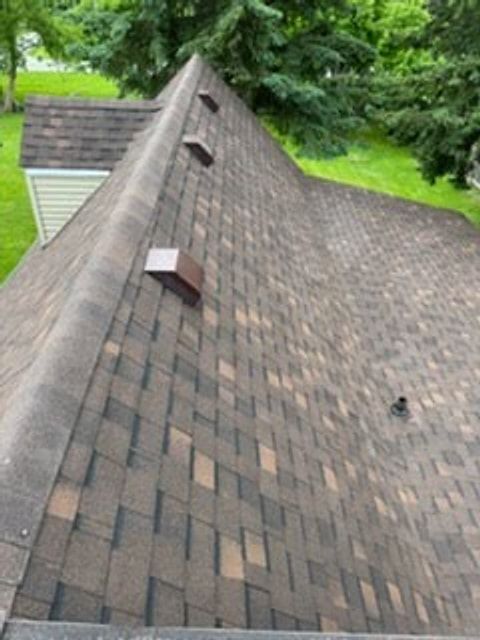
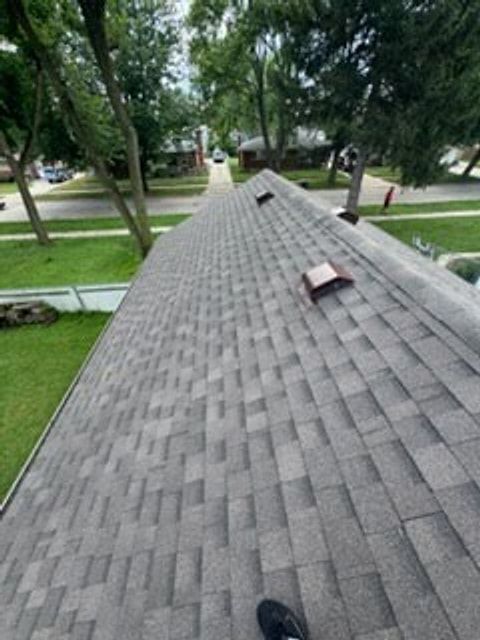
Architectural shingles, also called dimensional or laminated, are two or more layers bonded together. The bottom layer shows through gaps in the top one, which creates the shadow lines and the random, textured look. They are thicker and noticeably heavier per square, and that extra mass is a big part of why they hold up better.
Southeast Michigan gets summer thunderstorms with straight-line winds, and the National Weather Service calls a storm severe once winds reach 58 mph. That number sits right at the edge of what most 3-tab shingles are warranted for.
Two cautions. First, a laboratory wind classification and a warranty are not the same thing; some 3-tab products pass the same lab tests as architectural shingles but are still warranted for far less. Second, nailing matters as much as the product. Nails set too high or too low can void wind coverage on any shingle. A good crew nails to the manufacturer’s line and uses the starter strips the warranty calls for.
On a well-ventilated Michigan house, 3-tab shingles typically last about 15 to 20 years and architectural shingles about 25 to 30. Home inspector life-expectancy charts land in the same place, at roughly 20 and 30 years. The thin single layer of a 3-tab shingle simply has less material to lose to sun, granule wear and freeze–thaw cycles. We go through every roofing material in How Long Does a Roof Last in Michigan?
3-tab gives a flat, uniform, older look that some ranch homes and cottages carry well. Architectural shingles read as more textured from the street, and their random pattern hides small waves in an older roof deck better than straight 3-tab rows. Some premium architectural lines are made to suggest wood shake or slate from a distance. In the subdivisions around Rochester Hills, Troy and Sterling Heights, a 3-tab roof increasingly stands out as the older one on the street.
Ballpark: National cost guides put architectural shingles at roughly 10 to 40 percent more than 3-tab, installed. On the shingles alone, one 2025 guide lists about $80 to $95 per square (100 square feet) for 3-tab material and about $100 to $165 for architectural.
The gap on the finished bill is smaller than the gap on the bundles. Tear-off, disposal, underlayment, the ice barrier at the eaves, flashing, vents and labor cost about the same either way, so the shingle upgrade is only one line in a larger total. One 2026 national guide puts the installed difference on a typical house at around 10 percent. For what drives the rest of the number, see What a Roof Replacement Costs in Michigan in 2026.
Shingle manufacturers have been cutting back their 3-tab lines for years. Color choices are thinner, some lines are no longer stocked in certain regions, and at least one major manufacturer’s product page now checks your ZIP code before it will say whether its 3-tab shingle is sold there. Some 3-tab lines are still sold in many markets, but you cannot count on any particular color lasting.
That matters most for repairs. If a storm takes off a section of an older 3-tab roof, finding a shingle that matches in size, color and weathering can be hard, and sometimes impossible, and a patch that does not match stands out from the street. Putting new 3-tab on a house you plan to keep for 15 years means betting the line will still exist when you need a bundle.
Impact-resistant shingles are rated under a test called UL 2218. To earn Class 4, the top rating, a sample has to survive a 2-inch steel ball dropped from 20 feet onto the same spot twice without cracking through. Most Class 4 shingles are architectural-style, and many use rubber-modified asphalt that flexes on impact instead of fracturing.
A few honest points:
If your neighborhood has had hail claims in the last few years, it is worth pricing. Our post on hail damage and your roof insurance claim in Michigan covers the claim side.
| 3-tab | Architectural | Class 4 impact-resistant | |
|---|---|---|---|
| Construction | One flat layer with cutouts | Two or more laminated layers | Usually laminated; often rubber-modified asphalt |
| Look | Flat, uniform rows | Dimensional, shadow lines | Same as architectural |
| Typical wind warranty | 60 to 70 mph | 110 mph, often 130 with special installation | Varies by product |
| Typical lifespan | 15 to 20 years | 25 to 30 years | Comparable to architectural |
| Hail rating | Not usually impact-rated | Not usually impact-rated | UL 2218 Class 4 |
| Material cost | Lowest | Moderately more | Highest of the three |
| Availability | Shrinking | Standard on most reroofs | Common |
Whichever shingle you choose, the rest of the job is the same; our roof replacement page walks through how it runs.
Not entirely, but manufacturers have been shrinking their 3-tab lines for years, with fewer colors and spotty regional availability. Matching an older 3-tab roof for a repair is getting harder as a result.
National cost guides put architectural shingles at roughly 10 to 40 percent more than 3-tab, installed. Because tear-off, underlayment and labor cost the same either way, the difference on a full replacement usually lands toward the lower end.
Sometimes. Some insurers offer a discount for a UL 2218 Class 4 roof in Michigan and others do not, and state law does not require one. Ask your insurer which products qualify and what proof they need before you choose a shingle.
Architectural shingles typically last about 25 to 30 years in Michigan, compared with about 15 to 20 for 3-tab. The thicker laminated construction holds up better against wind, sun and freeze–thaw cycles.
Call and ask — or send the form and we'll come out, look, and give you a written estimate. Free for homes and businesses.
Keep reading
How attic ventilation works on a Michigan home: intake and exhaust, the 1/150 and 1/300 rules, blocked soffits, and the signs your attic isn't breathing.
How long does a roof last in Michigan? Lifespans by material, why freeze-thaw winters and ice dams wear roofs out early, and how to get more years from yours.
The roof repair or replace call comes down to age, how much is damaged, layers, decking and your plans. A plain guide for Michigan homes, with a quick table.