How to Prevent Ice Dams Before Michigan Winter
Ice dam prevention for Michigan homes: why ice dams form, the attic fixes that stop them, an honest look at heat cables, and what to do if water gets in.
Commercial roofing
Offices, retail, light industrial and multi-unit buildings. We repair, coat, maintain and replace commercial roofs, and plan the work around your business instead of the other way around.
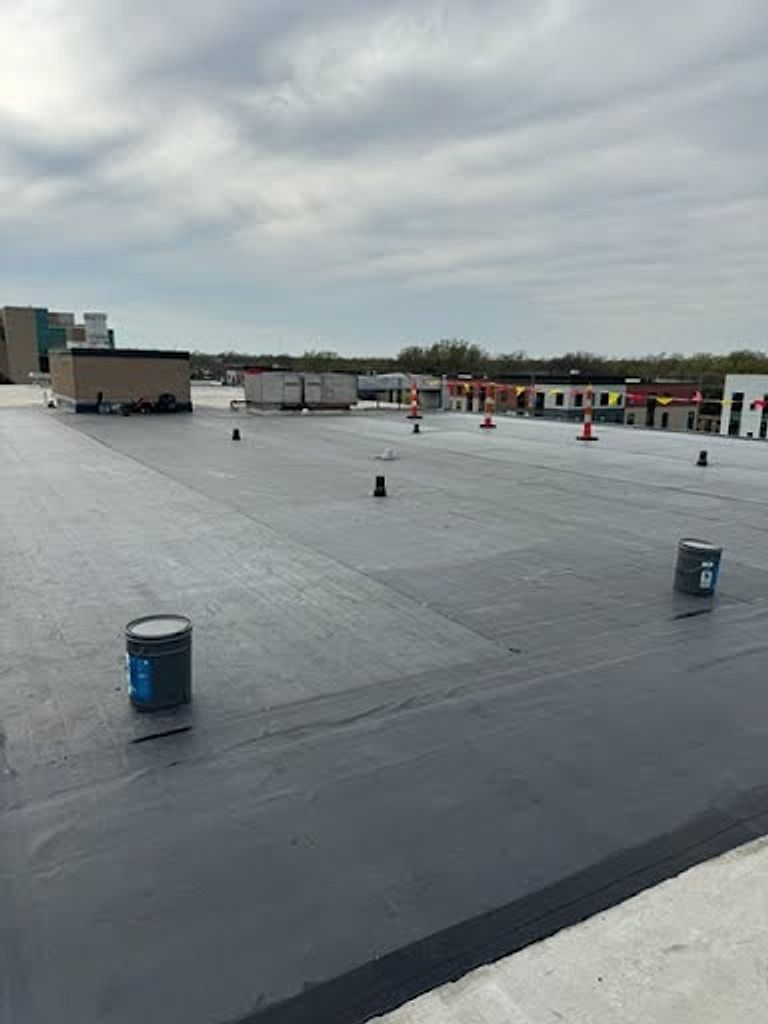
Commercial roofing is a different job from a house. Most commercial buildings around Rochester Hills, Troy, Auburn Hills and Sterling Heights have a flat or low-slope roof — a single-ply membrane like TPO or EPDM, modified bitumen, or an older built-up roof — or a metal roof. Each fails in its own way and has its own fixes, and a leak over a storefront, an office or a stockroom costs more than the repair.
There’s no single best commercial roof. TPO, EPDM and modified bitumen all perform well in Michigan when they’re installed and maintained properly; the right one depends on the building, how the roof is used and drained, what’s on it, and the budget. Our plain-language comparison — TPO vs. EPDM vs. mod bit — covers the trade-offs.
Commercial roof work goes better with a plan everyone has agreed to:
Most commercial roofs that fail early weren’t neglected for one big reason — they were neglected for a dozen small ones: a drain clogged with leaves, a seam opened by an HVAC tech’s boots, a flashing nobody looked at for five years. A simple twice-a-year maintenance plan keeps those from adding up. Here’s what a commercial roof maintenance plan should include.
J&M Roofing works with business owners, property managers and HOAs throughout Oakland and Macomb County and the rest of our service area. Request a free estimate or call to set up a time to walk the roof.
FAQ
In most cases, yes. Commercial roof work is planned in sections so the building stays dry and open, and the noisiest work can be scheduled around your hours. The plan, the schedule and how the site will be kept safe are agreed before anything starts.
A recover — a new membrane over the existing roof — can make sense when the existing insulation is dry and there's only one roof on the building. If moisture has soaked into the insulation, it has to come off. A moisture check and test cuts tell you which, so the decision isn't a guess.
Twice a year, in spring and fall, and after any major wind or hail storm. Regular, documented inspections catch small problems early and are often required to keep a manufacturer's roof warranty valid.
Yes. Metal roofs on commercial and industrial buildings are repaired at the seams, fasteners and flashings, and a sound metal roof can often be sealed and coated to stop leaks and add years instead of being replaced.
Related reading
Ice dam prevention for Michigan homes: why ice dams form, the attic fixes that stop them, an honest look at heat cables, and what to do if water gets in.
A commercial roof maintenance plan for Troy, Auburn Hills and Sterling Heights buildings: what to inspect, how often, and the records that protect a warranty.
A fall roof inspection checklist for Michigan homes: gutters, flashing, sealant, shingles, the attic, vents, branches and flat roof drains before snow.
Call and tell us what's going on with your roof, or send the estimate form. We'll set up a time to come out and look.