What a Commercial Roof Maintenance Plan Should Include
A commercial roof maintenance plan for Troy, Auburn Hills and Sterling Heights buildings: what to inspect, how often, and the records that protect a warranty.
TPO, EPDM and mod bit compared for a commercial flat roof in Michigan: seams, lifespan, cold weather, reflectivity, repairs and rough cost per square foot.
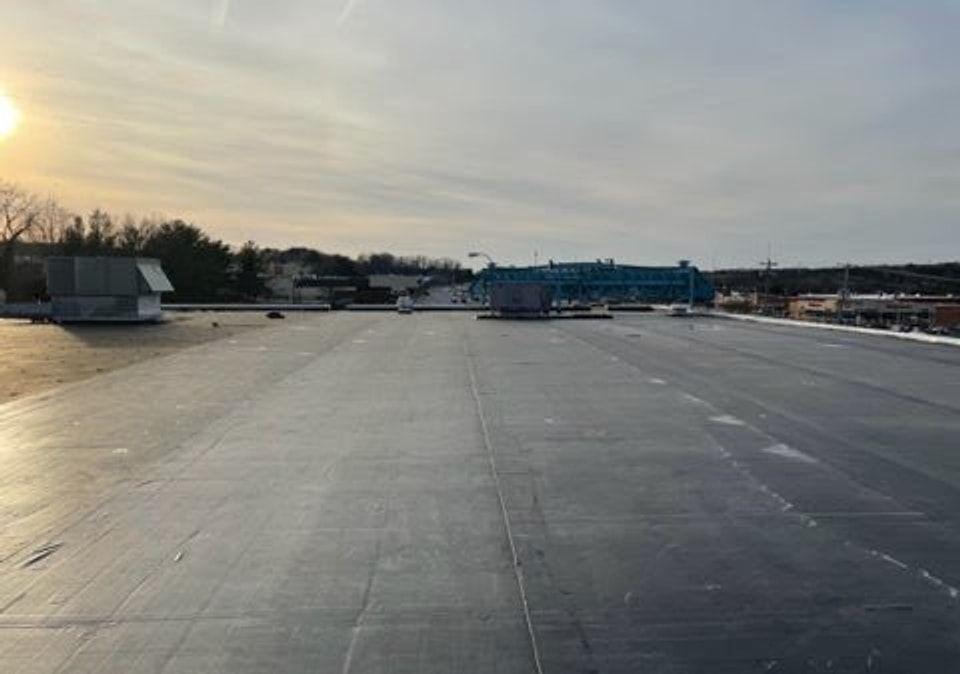
On a commercial flat roof in Michigan, TPO, EPDM and modified bitumen can each last 20 years or more when they are installed and detailed well. EPDM is a rubber sheet with taped seams that stays flexible in the cold. TPO is a white plastic sheet with heat-welded seams. Mod bit is a two- or three-ply asphalt system that stands up to foot traffic. The right choice depends less on the membrane than on the building: how it drains, how much traffic the roof gets, and whether the old roof can stay or has to come off.
EPDM is a synthetic rubber sheet, usually black, sold in wide rolls so a roof ends up with fewer seams. It is glued down, fastened through the insulation to the deck, or held in place with stone ballast. Seams are joined with primer and seam tape.
TPO is a single-ply thermoplastic sheet, almost always white. Its seams are melted together with a hot-air welder, so two sheets become one piece. It is fastened to the deck or fully adhered.
Mod bit is asphalt blended with a rubber (SBS) or plastic (APP) polymer and laid in two or three plies. The laps are fused with a torch, hot asphalt, cold adhesive or a self-adhered sheet, and the top ply carries granules or a coating to protect it from the sun. It is the modern descendant of the old tar-and-gravel roof.
Most membrane roof leaks start at a seam, a flashing or a penetration, not in the open field of the sheet.
EPDM stays flexible well below freezing, a large part of why it has long been popular in the northern states. SBS is the cold-climate version of mod bit; manufacturers steer the stiffer APP toward hot southern climates.
TPO is stiff in the cold. Once it is down, it performs fine through the winter, but a late-fall install takes care: rolls get warmed before they are unrolled, and welder settings get re-tested as the day warms or cools.
On every system, ponding water does more harm than cold. The industry treats water still standing 48 hours after rain as ponding, and in Southeast Michigan that water freezes, thaws and works at the seams all winter. Tapered insulation and clear drains matter more than which membrane goes on top.
A clean white TPO roof reflects roughly 70 to 80 percent of sunlight when new, according to rated product listings, and somewhat less once it weathers. Black EPDM reflects under 10 percent. In Phoenix, where the air conditioning runs most of the year, that gap is real money. Here it shrinks:
Energy modeling from Lawrence Berkeley National Laboratory found that cool roofs usually still come out slightly ahead in cold climates, because summer savings outweigh a small winter heating penalty. Both numbers are small, though, and the energy code does not require a reflective roof in our climate zone. A white roof earns its keep on a building with big rooftop air-conditioning units or a top floor that runs hot. Otherwise, choose the membrane for its seams, drainage and repairability, and if the budget forces a choice, put the money into insulation.
EPDM patches well at almost any age with primer and a peel-and-stick cover strip, as long as the old rubber is scrubbed clean first. TPO welds easily to itself while it is young; older TPO needs its weathered surface cleaned before a patch will take, and a sheet worn thin may not take one well. Mod bit is the simplest to patch, with another piece of mod bit or a reinforced mastic, and it shrugs off the foot traffic around rooftop units.
| EPDM | TPO | Mod bit (SBS) | |
|---|---|---|---|
| Usual color | Black (white available) | White (also gray, tan) | Granules or coating |
| Seams | Primer and seam tape | Hot-air welded | Torched, mopped, cold-adhesive or self-adhered laps |
| Typical lifespan | About 20 to 30 years | About 20 to 30 years | About 15 to 25 years, more for three-ply |
| Cold weather | Stays flexible | Stiff to install; fine once down | Stays flexible |
| Reflectivity | Low | High while clean | Depends on surfacing |
| Repairs | Easy with good prep | Easy while young, harder with age | Easiest |
| Foot traffic | Needs walkway pads | Needs walkway pads | Handles it well |
| Rough installed cost | About $5 to $13 per sq ft | About $5 to $14 per sq ft | About $4 to $9 per sq ft (two-ply) |
Ballpark: National cost guides for 2025 and 2026 put installed membrane roofs mostly between about $4 and $14 per square foot. Tearing off the old roof adds roughly $1 to $5 per square foot, and insulation board runs about $1 to $1.50 per square foot for each inch of thickness. An insulated three-ply system with a full tear-off can land well above the headline range.
The membrane is often a smaller share of the bill than people expect. Roof size (small roofs cost more per foot), curbs and penetrations, edge metal, tapered insulation and tear-off move the price more. When you compare bids, line them up item by item, including how wet areas will be handled. Our commercial roofing and flat roofing pages describe how we scope that work.
A recover puts a new membrane over the existing roof, usually with a cover board between them. It skips the tear-off and keeps the building closed up during the work. It makes sense when:
Tear-off is the better call when there are already two roofs, wet insulation is spread across the roof, the deck is rusted or rotted, or the roof needs new tapered insulation to stop ponding. Trade articles put the tipping point around a quarter or more of the insulation being wet, though where the water sits matters as much as the percentage. Tearing off to the deck can also bring the insulation under current energy code rules, so check with your city or township building department early. We walk through the same thinking for any roof in Roof Repair or Replacement? How to Decide.
Installed well, EPDM and TPO both typically last about 20 to 30 years, and a three-ply SBS mod bit roof can reach the same range. Drainage, seam quality and regular inspections affect the real number more than the membrane does.
National cost guides put them in overlapping ranges, roughly $5 to $14 per square foot installed, with EPDM often slightly lower. Insulation, tear-off and roof penetrations usually move the total more than the membrane choice.
Often, if the existing roof is a single layer, the insulation is dry, and the deck is sound. Building code does not allow a recover over a water-soaked roof or where two roof coverings already exist, so a moisture survey with core cuts should come first.
A little, mostly on buildings with large rooftop air-conditioning units. A short cooling season, weak winter sun and snow cover shrink the benefit, and the energy code does not require a reflective roof in our climate zone, so insulation usually matters more than color.
Call and ask — or send the form and we'll come out, look, and give you a written estimate. Free for homes and businesses.
Keep reading
A commercial roof maintenance plan for Troy, Auburn Hills and Sterling Heights buildings: what to inspect, how often, and the records that protect a warranty.
When a roof coating pays off on a flat or metal roof: silicone vs acrylic, which roofs qualify, the prep that matters, Michigan's cure window and lifespan.
Ice dam prevention for Michigan homes: why ice dams form, the attic fixes that stop them, an honest look at heat cables, and what to do if water gets in.