What a Commercial Roof Maintenance Plan Should Include
A commercial roof maintenance plan for Troy, Auburn Hills and Sterling Heights buildings: what to inspect, how often, and the records that protect a warranty.
When a roof coating pays off on a flat or metal roof: silicone vs acrylic, which roofs qualify, the prep that matters, Michigan's cure window and lifespan.
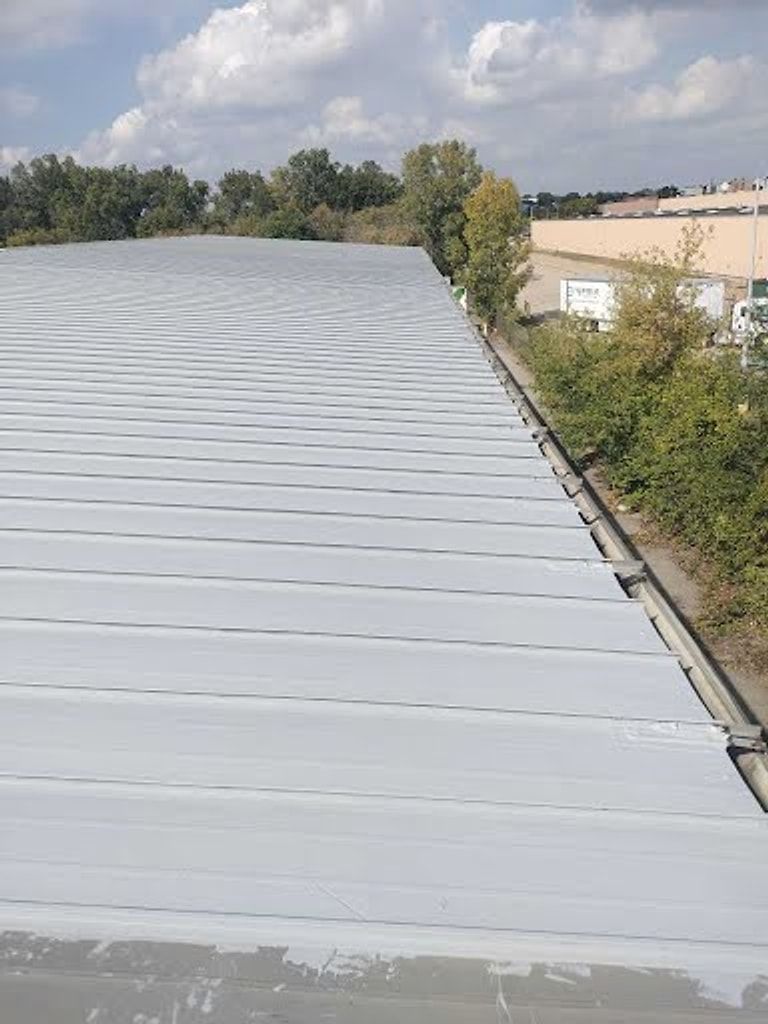
A roof coating pays off when the roof underneath it is still sound: the membrane or metal is intact, the insulation is dry, and the trouble is age, sun damage, or leaky seams and fasteners. Applied to the right thickness on a roof like that, a coating can add roughly 10 to 20 years for a fraction of the cost of a tear-off. It does not pay off over wet insulation, a rotted or rusted-through deck, or a roof that holds water it was never built to hold. That is lipstick on a failing roof, and the leaks come back.
A restoration coating is a liquid-applied membrane, rolled or sprayed on in thick coats and measured in mils (thousandths of an inch) once it dries. It cures into a seamless, rubbery skin that seals seams and fastener heads, blocks the sun’s UV, and, in white, reflects heat.
It is not structural. It will not dry out wet insulation, stiffen a sagging deck, or hold together a membrane that has already split. Its job is to protect a roof that still works.
Silicone tolerates standing water far better than acrylic, which makes it the usual pick for flat roofs with low spots. It cures with moisture from the air, many products can go down at 40°F, and some are rain-safe within minutes to an hour. The trade-offs: it collects dirt, which dulls its reflectivity, and it is slick when wet. Only silicone sticks to silicone, so a silicone roof gets recoated with silicone.
Acrylic is water-based, costs less, and stands up well to sun. It suits sloped metal roofs, where water runs straight off. It does not like ponding water; one manufacturer’s data sheet says its acrylic is not intended for water standing beyond 72 hours. It also needs warmer, drier weather to cure, which matters in Michigan.
Urethane coatings are tougher and handle foot traffic better, at a higher price. There are also rubber-based (SEBS) coatings and aluminum asphalt coatings, the latter common on older mod bit and built-up roofs. The choice should follow the roof, not the other way around.
| Silicone | Acrylic | Urethane | |
|---|---|---|---|
| Ponding water | Tolerates it | Not suited to it | Varies by product |
| Typical minimum application temperature | Often 40°F; cures slower in cold | 50°F and rising | Per product data sheet |
| Strengths | Ponding, UV, quick rain resistance | Cost, UV, sloped metal | Toughness, foot traffic |
| Watch-outs | Dirt pickup, slippery, silicone-only recoats | Ponding, cold, dew and rain while curing | Higher cost |
If you are still choosing the roof itself, TPO vs. EPDM vs. Mod Bit: Choosing a Commercial Flat Roof compares the membranes these coatings go over.
The most important step happens before anyone opens a pail: finding out whether the insulation is dry. An infrared, nuclear or capacitance survey maps likely wet areas, and core cuts confirm them. Wet insulation does not dry out under a coating. It rots the deck, rusts fasteners, and keeps leaking.
Small, contained wet areas can be cut out to the deck and replaced before coating. Once the wet area grows large, coating stops making sense. One coating manufacturer’s guidance says not to install its system at all if 20 percent or more of the roof is wet, and trade articles commonly put the tear-off point around 25 percent.
A coating is the wrong fix when:
In those cases the money is better spent on flat roofing replacement or a recover. A good contractor will tell you that before quoting a coating.
Coatings fail at the prep, not in the pail. On any roof, the surface gets cleaned (usually power-washed, with a cleaner suited to the membrane), dried, repaired, and adhesion-tested.
On a metal roof, prep also means:
Then the base and top coats go on at the thickness the system calls for, checked with a wet-mil gauge as the crew works. Thin spots are where a coating wears through first.
Weather decides when a coating can go down here. Many acrylic data sheets require 50°F and rising, no rain, dew or freezing in the forecast for hours afterward (a full day or two on some products), and a roof surface several degrees above the dew point. Silicone is more forgiving, with many products rated down to 40°F, though it cures more slowly in the cold.
Detroit’s normal overnight lows run about 50°F in May, 60°F in June, 55°F in September and 44°F in October. In practice that makes June through mid-September the dependable window for acrylic, with late May and late September possible on the right stretch of weather. Silicone can stretch a few weeks further into spring and fall on dry days. Heavy dew on clear fall mornings is the hidden problem, because the crew has to wait for the roof to dry before starting.
Ballpark: Restoration coatings commonly last about 10 to 20 years, depending on the product and how thick it goes on. Manufacturers tie warranty length to dry thickness, typically somewhere around 20 to 35 dry mils for 10- to 20-year terms. Cost guides put an installed silicone coating at roughly $1.50 to $4.50 per square foot, before repairs and wet-area replacement.
At the end of that life, the roof usually does not need a tear-off. It gets cleaned, the worn spots get repaired, and a maintenance coat goes on. That renewability is the real case for coatings on commercial roofing jobs: a sound roof can be kept in service far past its original life. Our roof coatings page covers the work we do on flat and metal roofs.
Silicone is usually the better fit for a flat roof because it tolerates ponding water and can be applied in cooler weather. Acrylic costs less and works well on sloped metal roofs that drain quickly, but it needs warm, dry weather and does not hold up under standing water.
No. Wet insulation has to be found with a moisture survey, confirmed with core cuts, and cut out and replaced before coating. If a large share of the roof is wet, replacement usually makes more sense than a coating.
A restoration coating commonly lasts about 10 to 20 years, depending on the product and its dry thickness. When it wears, the roof can usually be cleaned and recoated instead of torn off.
Many acrylic coatings need at least 50°F and rising, with no rain, dew or frost expected for hours after application. Many silicone coatings can go down at 40°F, though they cure more slowly, so the practical season in Southeast Michigan runs roughly late spring through early fall.
Call and ask — or send the form and we'll come out, look, and give you a written estimate. Free for homes and businesses.
Keep reading
A commercial roof maintenance plan for Troy, Auburn Hills and Sterling Heights buildings: what to inspect, how often, and the records that protect a warranty.
TPO, EPDM and mod bit compared for a commercial flat roof in Michigan: seams, lifespan, cold weather, reflectivity, repairs and rough cost per square foot.
Ice dam prevention for Michigan homes: why ice dams form, the attic fixes that stop them, an honest look at heat cables, and what to do if water gets in.